Saturday, January 10, 2015

7 Charts That Show the Disaster That Would Have Been The Confederate States of America

Had the south won the Civil War in 1865 and created the Confederate States of America at the Maryland-Virginia border the situation economically would have been unsustainable and deteriorated so badly that it would have been a nightmare for its residents. War on your soil is never good for your economy but the Confederate States of America (CSA) would have never survived had they won the Civil War. Never mind the the very obvious population migration to what would have been pro-union people to the north the war would never ended in the South. Even after a concession and treaty with the Union the war for the south would have still continued for decades or generations to come.

As evidenced by this map of slave population concentrations they would have continued fighting the war through uprisings and rebellions even if the Union Army would have conceded. Source


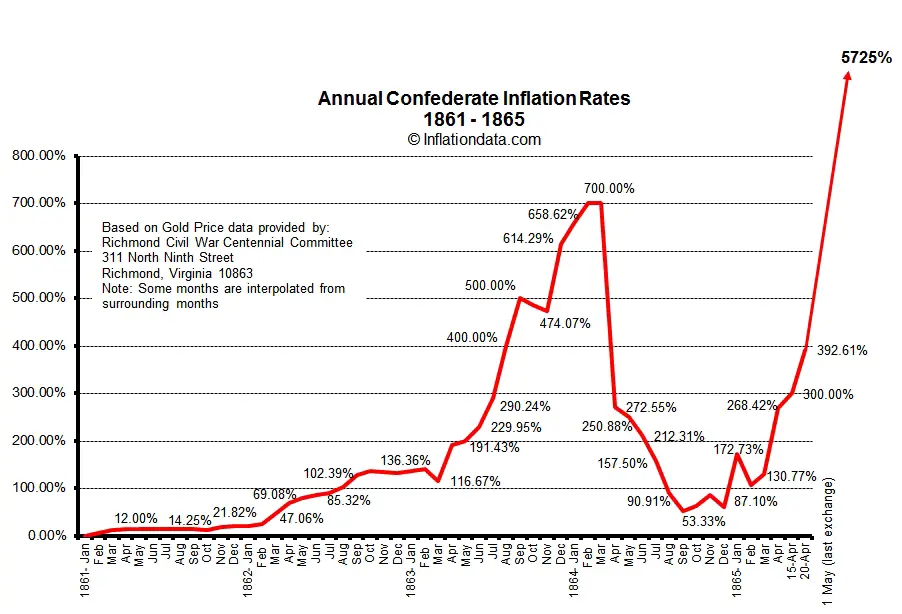
Being in a constant state of war (either from slave rebellions or impending Union Army invasions also don't forget the Mexican army who might want Texas back) the Confederate State's of America would have experienced prolonged sustained bouts of high inflation on goods and services due to their constant state of or potential state of war. 


not to mention pressure on prices


Inability to finance the war effort would have likely spilled over to an inability to finance the reconstruction of the CSA. There was a vast effort in the re-unified United States to re-construct the south. This chart shows quarterly growth rate of the Confederate primary deficit in real terms. The negative values after third quarter 1862 reflect mostly the inability to find willing purchasers for Confederate debt as the military situation of the South deteriorated (source


There would have been no one left to buy CSA debt. Without this ability they would not have had the ability to finance project for construction like their railroad network which served as the veins of their economy. Most of the railroad was incomplete prior at the start of the Civil War and would have needed significant improvements. One historian noted it would take a generation to restore the railroad system in the south


Re-building the railroads took a generation and this was WITH the help of Northern states during reconstruction. With a lack of an ability to finance re-construction and infrastructure CSA trade and their economy would collapse leading to the crumbling of tax collections and an eventual collapsing of their bond markets 


Of course this is an exercise of "what ifs" but we do have a slight window into how awful the CSA would have been as a place to live in a post CSA victory world. 


Some people argue the south never recovered from the Civil War. 


Monday, February 24, 2014

Guns Kill More Than Cars Do... And It Is Getting Worse


This chart was released along with some analysis from ThinkProgress showing that gun deaths are surpassing, this year, auto deaths for the leading cause of death in people under 26. In 12 states guns already kill more people than cars that has been true since 2010, when you simply look at raw numbers the story becomes even bleaker. Account for the fact that 90% of all US household interact daily with a car, but only 30% interact with a gun your odds of being killed by a car is far greater than being killed by a gun. Yet this chart below shows the opposite for people in the  15-24 year old co-hort. For them being killed by guns is the leading cause of death. 


The study from The American Center for Progress, Young Guns: How Gun Violence is Devastating the Millennial Generation shows a stark reminder that guns are the leading cause of death among young people. In fact the situation is getting worse. 

Overall, there were 31,672 firearm deaths in 2010 and 35,498 motor vehicle deaths. Compare these numbers to 1999, when there were 28,874 firearm deaths and 42,624 motor vehicle deaths. This is an upward trend. In the same eleven year period that guns became more dangerous cars became safer, killed less drivers. Why? The introduction of seat belt laws, DUI enforcement measures, speed limit implementation and enforcement, and regulatory safety checks on vehicle performance all played a heavy factor in the reduction of auto deaths. None of these policies were a single silver bullet that has pulled down the auto deaths, but in combination they reduced the numbers over time. What have we done in the same 11 year period to curb the gun violence problem? Hardly anything. 

More than 1 million years of potential life are lost due to gun deaths each year. These are years of life that young people killed by guns would have achieved educational milestones, entered the workforce, had families, and contributed to the social, economic, and cultural advancement of society in untold ways—all erased by gunfire.

Wednesday, February 19, 2014

You Should Care About Student Loan Debt

Students are not paying their loans back.  This is EVERYBODY'S problem. The crippling debt is stiffling the housing recovery which is continuing to be a major drag on the overall economy.

seriously delinquent loans 800x581 Why Everyone Should Care About Student Debt

Tuesday, February 18, 2014

Guns Don't Kill People, People Kill People... Missouri Edition

Guns don't kill people, people kill people and in Missouri that is exactly what happened when they repealed their gun background check laws. According to a study out of Johns Hopkins gun deaths increased by 23% since Missouri's state legislature repealed the background checks

The report concluded 
The law’s repeal was correlated with a 23 percent spike in firearm homicide rates, or an additional 55 to 63 murders annually from 2008 to 2012, according to the study conducted by researchers with the Johns Hopkins Center for Gun Policy and Research and to be published in the Journal of Urban Health.
“This study provides compelling confirmation that weaknesses in firearm laws lead to deaths from gun violence,” Daniel Webster, director of the Johns Hopkins Center for Gun Policy and Research and the study’s lead author, said in a news release. “There is strong evidence to support the idea that the repeal of Missouri’s handgun purchaser licensing law contributed to dozens of additional murders in Missouri each year since the law was changed.”
Good luck out there Missourians.

No, A Minimum Wage Hike Won't Destroy Jobs...

The minimum wage hike will not lead to job loss because of the economic multiplier effect. In lay mans terms this means putting additional money in the hands of people who spend it will help boost not deflate the economy.

A report from the Economic Policy Institute backs this theory up
Based on the economic multiplier effect that results from putting additional income in the hands of lower-income workers, raising the minimum wage will likely have a modest but positive impact on job creation, leading to an additional 85,000 net new jobs when fully phased in. Lower-income earners spend their income more immediately, more completely, and more locally, than do higher income earners, and therefore generate more economic activity. Increasing the wages of 27.8 million workers by $35 billion over the phase-in period generates an additional GDP impact of $22 billion.
So, yes some jobs will be lost. The multiplier effect will actually improve the over all economy. I think one of the most telling aspects of the CBO report on the increase in minimum wages is that it will reduce HHS spending around Obamacare. The more income people are making the less money they qualify for in health care subsidies, reducing the government burden further. People are really running out of reasonable arguments to make for not raising the minimum wage.

CBO: $10.10 An Hour Will Lift 900,000 Out Of Poverty

The Congressional Budget Office released an initial report on the $10.10 an hour unemployment projects.  The initial estimates claim that raising the minimum wage to $10.10 an hour will boost the unemployment numbers by 500,000 people. Of course that sounds terrible until you dig further into the report. While 500,000 people can expect to lose their jobs the wage increase will affect roughly 16.5 million people boosting 900,000 people out of poverty. Real income would increase, on net, by $5 billion for families whose income will be below the poverty threshold under current law. This will boost family income by about 3 percent.  Not to mention the benefits of reducing the social service rolls. Read more about that here. 

So before everyone freaks out about the increase in unemployment this becomes a simple cost benefit analysis. The boost in wages will result in additional income for the people who need it most. Most importantly the people who will spend it. Lifting 900,000 people out of poverty will also give a kick to the economy as well. So don't believe the doom and gloom, $10.10 is going to benefit us in the long run.

Of course the best argument to make is this...

Why Conservatives Should Back A Minimum Wage Increase

Raising the minimum wage allows low income workers (the working poor) to have a livable wage. Putting the burden for providing a living wage on the private sector businesses can help governments reduce their social programs, saving the tax payers billions of dollars annually. Why are conservatives so resistant to this argument? 

To the business owners who claim that increasing minimum wage will hurt their bottom line I say to you if you can't afford your workforce than perhaps a business that as a more efficient model should take your place. That would be a true free market system. By increasing the minimum wage to $10.10 an hour you could move millions of unskilled workers out of poverty moving them off of programs like food stamps which are costing the tax payers hundreds of billions of dollars a year, adding to the deficit conservatives pretend to care so much about.